How Do Cat-Eye Nails Work? The Magnet, the Gel and Why Yours Went Flat
That moving band of light is not a special polish and not a trick of the top coat. It is iron, physics and a ten-second window before the lamp.
by Haider Ali5 min readupdated september 17, 2026
in this guide
Cat-eye is the finish that makes people stop mid-conversation and ask what you have on. It looks like a light source moving inside the nail, and the explanation is simpler than the effect: the gel is full of tiny reflective metal flakes, a magnet pulls them into a line while the gel is still liquid, and the lamp freezes them there. Everything else, from the depth of the stripe to why the two hands never quite match, follows from those three facts.
What is in the bottle
A magnetic gel is an ordinary coloured gel with a large dose of microscopic iron-based flakes. Lying flat, they reflect light evenly and the gel just looks metallic. Pulled upright by a magnet, they stand on edge in a band and reflect a bright line at one angle, dark at another. That is the "eye." Move your hand and the line moves, because the angle between the flakes, the light and your eye is changing.
The colour comes from the pigment around the flakes. Emerald, burgundy, teal and black are the classics because a dark background makes the light band pop. That contrast is why the Emerald Flicker reads so deep and why pale cat-eyes like Rosé Whisper are softer and subtler: there is less darkness for the light to play against.
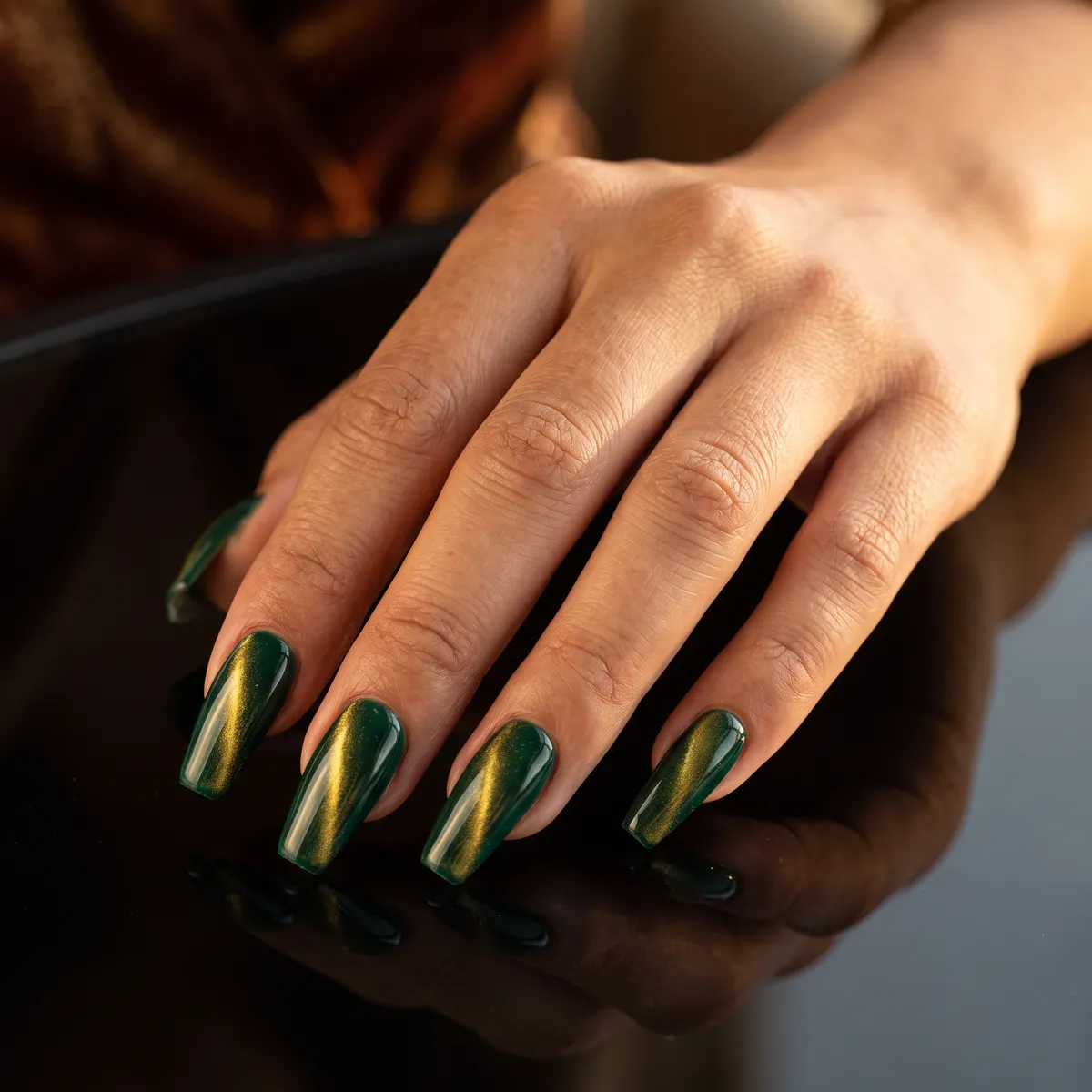
The magnet is doing all the work
The flakes go where the magnet's edge is. Not where the magnet's body is: the edge. Hold a bar magnet flat above the nail and you get a broad soft glow. Tilt it so one edge is closest and you get a sharp line along that edge. A pointed magnet makes a bright spot; a curved one makes an arc; two passes at different angles make a cross or a double band.
Distance matters as much as position. A magnet a millimetre from the surface makes a crisp, narrow line. Five millimetres away, the field is weaker and wider, so the line blurs. Time matters least: two to five seconds is plenty, and holding it longer changes nothing except your patience.
The window closes when the lamp comes on. Until then the flakes are floating and will drift if you move the hand, tilt it, or bump the magnet. That is the entire skill: position, hold still, cure.
Doing it at home
You need a magnetic gel, a magnet, a lamp, a base coat and a no-wipe glossy top coat. Then:
- Prep and base coat as for any gel manicure. Cure.
- Apply a thin coat of the cat-eye gel. Cure it. This first coat gives colour depth; you are not shaping it.
- Apply a second, slightly fuller coat and do not cure yet. The gel needs enough body for the flakes to move in.
- Bring the magnet's edge close to the surface, in the position you want the line, and hold it for three seconds without moving the hand. For a diagonal like Oxblood Diagonal Flash, angle the magnet corner-to-corner. For a centre line, hold the edge along the middle.
- Without tilting the hand, put it straight under the lamp and cure. Do one nail at a time; the moment you move on to nail two, nail one starts drifting.
- Top coat and cure. Thin and glossy; a thick or matte top coat softens the effect.
Two habits make a matching set. Put a dot of polish on the magnet so you hold the same edge every time, and rest the magnet hand against the table so the distance is the same on every nail.
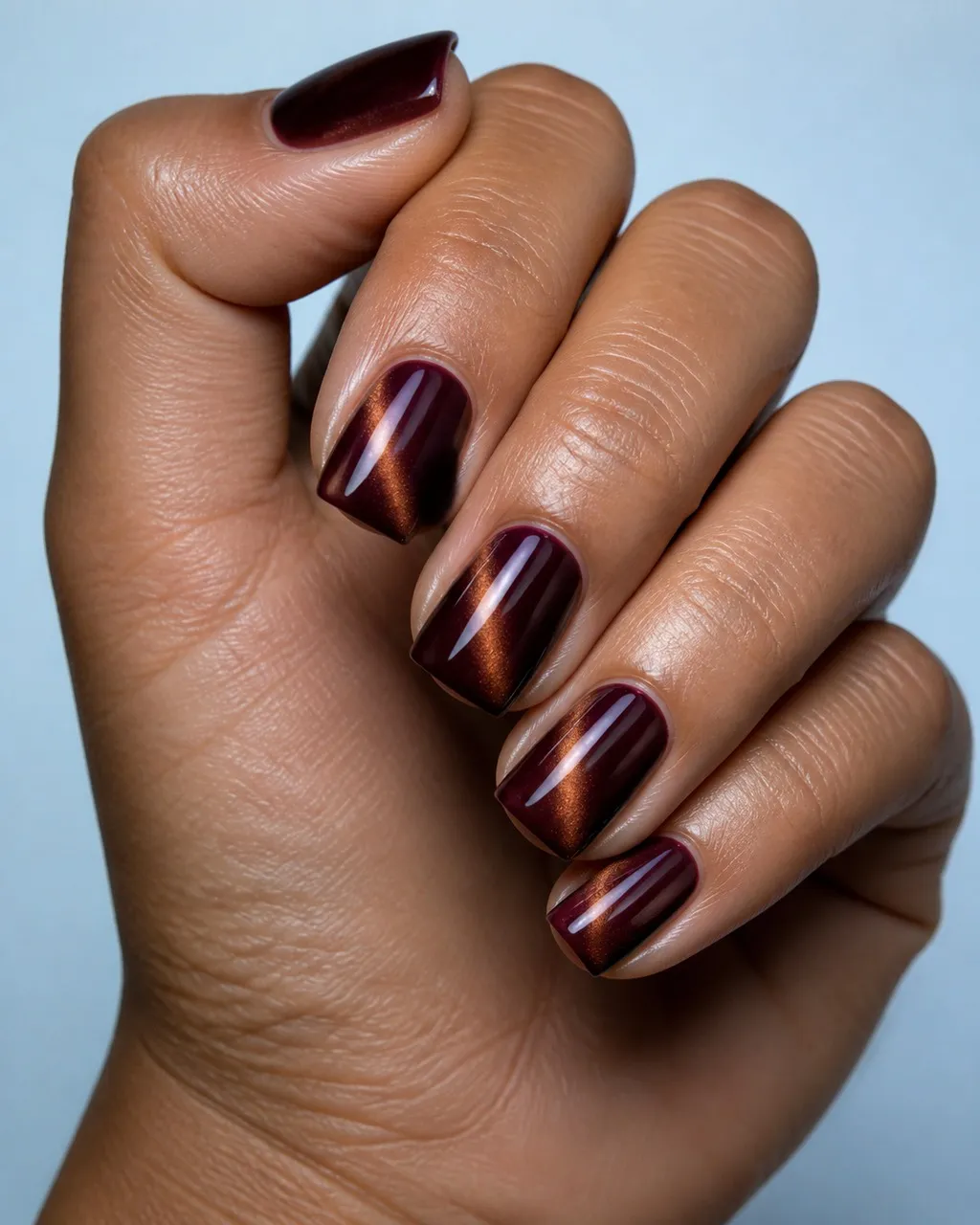
Why it went wrong
Almost every failed cat-eye is one of these.
| What you see | What happened | Fix |
|---|---|---|
| A soft glow, no line | Magnet too far away or held flat | Bring the edge to within a millimetre; tilt so one edge leads |
| Line is blurry or wide | Gel too thin to move, or magnet too far | Fuller second coat; closer magnet |
| Line drifted or doubled | Hand moved between magnet and lamp | Cure one nail at a time; keep the hand flat on the way to the lamp |
| Line in a different place on each nail | Magnet position varied | Mark the magnet; use the sidewall as a reference on every nail |
| Effect faded after top coat | Top coat dragged uncured flakes, or cloudy top coat | Full cure on colour; thin high-gloss top coat |
| Dull, flat metallic | The gel is not magnetic, or the flakes have settled in the bottle | Shake or roll the bottle for a minute; check it says magnetic or cat-eye |
| Patchy colour under the line | First coat too thin or skipped | Two coats: one for colour, one for the effect |
If the line is perfect on the first nail and worse on every nail after, the second coat is going on thinner as you get tired, or the bottle is settling. Roll it again and take a breath.
Cat-eye on top of other finishes
The magnetic layer can sit over a colour, not just over a base coat. A cat-eye over a sheer nude gives a soft, glassy "velvet" look; over black it gives the deepest stripe; over a chrome-glazed base it gets strange and beautiful. A French tip in cat-eye, like the Cat-Eye French Tips, is the magnetic gel painted as the tip only, magnetised, then cured, with a clear or sheer base underneath.
Velvet is the same product with the magnet held further away and moved slightly, so the flakes scatter instead of lining up. The Burgundy Velvet Cat Eye is that: depth without a hard line.
How it wears and comes off
A cat-eye is a gel manicure and wears like one: two to three weeks, with the usual things shortening it. The effect does not fade; it is locked in the cured layer. What fades is the gloss of the top coat, and a dull top coat makes the line look weaker than it is. A fresh thin top coat at week two brings it back.
Removal is a normal acetone soak; see the removal guide. The flakes are sealed inside the gel and come away with it. There is nothing special about the metal; it is not going anywhere near you.
Asking for it at the salon
Say "magnetic cat-eye gel" so there is no confusion with metallic polish, name the colour, and describe the line: straight, diagonal, a small spot, or velvet with no line. If you have a look saved from the cat-eye edit, the salon line under the photo already says all four. Ask to see the first nail before they do the rest; the line position is a two-second fix on nail one and a redo on nail ten.
Questions people ask
Can you do cat-eye nails with regular polish?
There are magnetic regular polishes, but the effect is weaker and fades as the polish dries because the flakes settle. Gel holds the flakes exactly where the magnet left them because the lamp freezes the layer in seconds. If you want the sharp, deep line in the photos, it is a gel product.
Does the magnet have to be a special nail magnet?
Any strong small magnet works. The nail magnets are shaped to give particular effects: a bar for a straight line, a point for a small bright spot, a curved edge for a soft arc. A fridge magnet is too weak; a small neodymium magnet from a hardware shop works well.
Why does the cat-eye line look different on each nail?
Because the magnet was held at a slightly different angle, distance or position on each one. The line goes exactly where the magnet edge was. Mark a position on the magnet with a dot of nail polish and hold it against the same reference point on each nail, usually the sidewall, for a matching set.
Why did my cat-eye go dull after top coat?
Either the top coat was applied while the colour layer was not fully cured and dragged the flakes, or a thick, cloudy top coat is sitting over the effect. Cure the colour fully, then apply a thin, clear, high-gloss top coat and cure again. Do not wipe over a cat-eye with alcohol between colour and top coat if you can avoid it.