What to Tell Your Nail Tech So You Get the Nails in the Photo
Most disappointing manicures are not a skill problem. They are a translation problem, and it happens in the first ninety seconds of the appointment.
by Haider Ali6 min readupdated september 17, 2026
in this guide
Every look on this site ships with one sentence written to be read out across a manicure table. That sentence exists because of a pattern I kept watching: someone arrives with a perfect photo, leaves with something technically fine, and cannot explain why it is wrong. The colour matched. The shape did not. Or the length. Or the finish was glossy when the photo was clearly a soft matte. The photo never said any of that, so the tech filled the gaps with defaults, and defaults are almost never what you saved.
This guide is the fix. It is not about being demanding. It is about giving a skilled person the four or five facts a photo cannot carry, in the order they need them.
Why the photo is not enough
A nail photo is a flat picture of a three-dimensional object, usually shot from above, usually with the hand posed to flatter the design. Three things get lost immediately.
Length is unreadable. A medium almond photographed from the front looks like a short almond photographed from the side. The tech will pick a length that suits your current nails, which is usually shorter than the picture, and you will feel short-changed.
Finish is unreliable. Studio lighting turns satin into gloss and gloss into glass. The Matte White French and the Milky Base White French can look nearly identical under a ring light and completely different on your hand.
System is invisible. A photo cannot tell you whether the nails are natural with gel polish, hard gel over the natural nail, acrylic, dip powder or full-cover tips. Each one changes what is possible, how long it takes, and what it costs.
The tech knows all this. What they do not know is which of those hidden variables you care about, so they guess, and a guess is a coin flip.
The five things a photo cannot say
Say these five things, in this order, and the photo becomes a confirmation instead of an interpretation.
- Shape. Round, squoval, square, almond, coffin or stiletto. If you do not know, say "the shape in the photo" and point, but be ready for them to translate it to what your natural nail can support. Our nail shapes guide covers which suits which hand.
- Length. Short, medium or long is too vague. Use a landmark: "just past my fingertip", "about the length of my thumbnail now", or hold up a finger from your other hand. Techs work in millimetres; give them something they can measure by eye.
- Finish. Glossy, matte, velvet or chrome. If the look has a magnetic or chrome effect, name it, because those are separate products and separate steps.
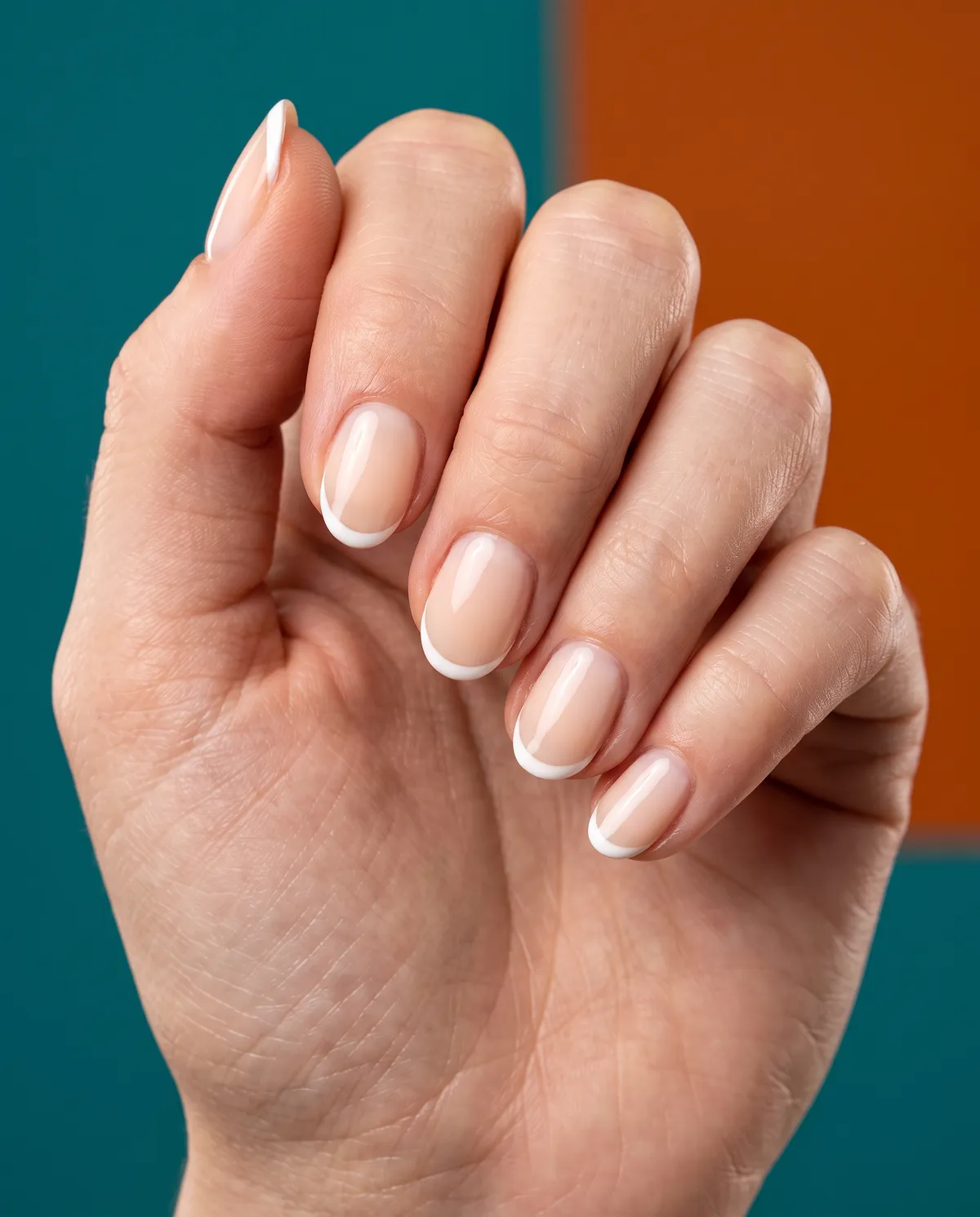
- Base. Sheer, milky, opaque or nude. This is the one people forget, and it changes everything. A French tip on a bare nail and a French tip on a milky base are different manicures with different price tags.
- System. Gel polish on your natural nails, builder gel for strength, or an enhancement (acrylic, hard gel, tips). If you are not sure, say what you want the nails to survive: "I type all day and they need to last three weeks" tells the tech more than any product name.
That is it. Five facts, one breath. Everything else is negotiable and the tech will happily lead.
The sentence, with blanks
Fill this in before you leave the house:
Worked example for the Glazed & Unbothered look: "Short almond, just past the fingertip, high gloss. Sheer milky base with a pearl chrome glaze over it. Gel polish, and I need them to survive three weeks of typing."
Nothing in that sentence is technical. Every word in it saves a question.
The vocabulary your tech uses
You do not need to speak salon fluently, but a handful of words stop the back-and-forth. These are the ones that come up on nearly every appointment.
| You say | The tech hears | Why it matters |
|---|---|---|
| Sheer | Colour you can see the nail through | Sheer shows imperfections; two thin coats, not one thick |
| Milky | Semi-opaque soft white or pink | The base under most modern French tips and glazes |
| Glaze / glazed | A fine pearl or chrome powder over a sheer base | A separate step and product; ask if they stock it |
| Chrome | Mirror powder rubbed onto tacky gel | Needs a no-wipe top coat under it; not every salon carries it |
| Cat-eye / magnetic | Gel with metal particles, shaped by a magnet | Our cat-eye guide explains the effect |
| Micro French | A tip line a millimetre or two wide | Needs a steady hand; ask if they do them |
| Smile line | The curve where the tip meets the base | "Deeper" or "flatter" tells them how curved you want it |
| Apex | The thickest point of the nail, usually near the middle | Where strength comes from on longer nails |
| Fill / infill | Filling the regrowth gap on enhancements | Cheaper than a new set; usually every two to three weeks |
| Cap the free edge | Sealing the tip with colour and top coat | The single best defence against chipping |
You will hear "cap the free edge" without asking; it is what a careful tech does automatically. The rest is worth saying out loud once.
Before the appointment
A few minutes of preparation removes most of the friction.
- Check they do the system you want. Not every salon offers chrome, cat-eye, builder gel or hand-painted art. A quick message saves a wasted visit.
- Bring the salon line, not just the picture. Every look here has one under the photo, with a copy button. Read it or show it.
- Bring a second photo if the length or finish is different from the first. Two photos that agree on colour but disagree on gloss is exactly the ambiguity you are trying to remove; say which one wins.
- Decide what you will compromise on. Colour is easy to match closely; a very specific art detail is not. Knowing which you care about more means you can answer in one word when asked.
- Know your budget and time. Detailed art can double the appointment. Saying "I have an hour" up front lets them propose the simpler version of the look.
When the salon does not have the colour
This happens constantly and it is not a disaster. The mistake is letting the tech pick the substitute alone. Ask for their two closest shades, hold them against your skin near a window, and answer one question: would you rather miss warmer or cooler, lighter or darker? For a burgundy like Burgundy Velvet Cat Eye, missing a touch darker is nearly invisible; missing a touch pinker turns it into a different colour. You know which direction matters to you; they do not.
If the look depends on a specific hex, and some of ours do, the shade library shows every colour on the site with its family and undertone so you can describe the direction rather than the exact number.
Asking for a change without the awkwardness
The moment to adjust is after the first finished nail, not the tenth. Ask to see it, hold it at arm's length, and judge three things: is the shape symmetrical with the nail beside it, is the tip line the thickness you wanted, and is the colour what it looked like in the bottle. "Could the tip be a touch thinner?" at nail one is a normal sentence. At nail ten it is a redo, and everyone knows it.
If you genuinely dislike the result at the end, say so plainly and early, and offer the compromise: "I love the colour, the shape is squarer than I pictured; could we soften the corners?" Most techs will fix that in minutes. What nobody can fix is a silent customer who leaves a bad review.
What this site does about it
Every design page here has three parts written for this exact conversation: the palette with its hex codes, the "ask your tech for" sentence, and the step list under "how this look is done" so you can see whether the look is a five-minute glaze or a forty-minute hand-painted job. Save the looks you want to the saved edit and the whole card, with all of that, can be shown or printed at the table.
The photo starts the conversation. The sentence finishes it.
Questions people ask
Is it rude to show my nail tech a photo?
No. Good techs prefer it, because a photo settles colour and vibe in seconds. What frustrates them is a photo with no other information, because it leaves them guessing about shape, length and finish, and then being blamed for the guess.
What if the salon does not have the exact colour?
Ask to see their closest two options side by side against your skin, in daylight if there is a window. Say which direction you would rather miss in, warmer or cooler, lighter or darker. A near-miss you chose beats a near-miss they chose.
Should I tell them a design is beyond my budget or time?
Yes, before they start. Most detailed looks have a simpler version: a single accent nail instead of ten, a French tip instead of full art, a plain glaze instead of chrome. Techs quote these happily when asked up front and resent it when asked halfway through.
How do I ask for a change without offending them?
Ask early and be specific. "Could the tip be thinner?" after one nail is a normal request. The same sentence after all ten is a redo, and that is where the tension comes from.